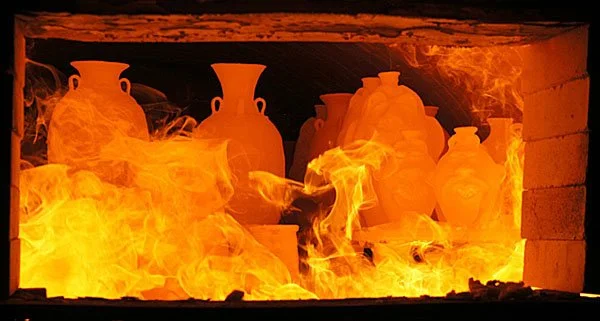
What is Firing?
Pottery firing generally requires two stages in a kiln: a bisque fire to harden the clay and a glaze fire to melt the glaze and vitrify the clay. Below are the firing ranges in Celsius and Cone numbers of each of the main firing types:
Bisque Fire: 960C to 1,030C / Cone 06–04.
Low-Fire (Earthenware): 900C to 1,150C / Cone 04–06.
Mid-Range (Stoneware): 1,150C to 1,260C / Cone 5–6.
High-Fire (Stoneware/Porcelain): 1,260C to 1,480C / Cone 9–10.
The firing process in pottery making serves the essential purpose of transforming raw, workable clay into a strong, durable ceramic object. This transformation is achieved through high temperatures that cause the clay particles to harden and bond together. Firing also plays a crucial role in setting glazes, ensuring they adhere properly to the clay and develop their intended colours and textures.
There are generally two main stages in the firing process: bisque firing and glaze firing. Bisque firing is the first stage, where the clay piece is heated at a moderate temperature to drive out physical water and organic matter, making it easier to handle and less likely to break when applying glaze. During this stage, the clay remains porous, which allows it to absorb the glaze more effectively. The second stage, glaze firing, involves heating the bisque-fired piece to a higher temperature, enabling the glaze to melt and form a glassy surface. This final stage locks the glaze in place and completes the transformation from a clay object to a finished ceramic piece.